Advanced version of Gemini with Deep Think officially achieves gold-medal standard at the International Mathematical Olympiad


Listen to article 10 minutes
Under direction from expert mathematicians and scientists, Gemini Deep Think is solving professional research problems across mathematics, physics, and computer science
In the summer of 2025, an advanced version of Gemini Deep Think achieved Gold-medal standard at the International Mathematics Olympiad (IMO) and later, an updated version, obtained similar results at the International Collegiate Programming Contest. These results demonstrated the model could reason through some of the most challenging math and programming problems designed for students. Since then, Gemini Deep Think mode has moved into science, engineering and enterprise workflows to tackle more complex, open-ended challenges.
In the last week, our teams published two papers (1, 2) detailing a cross-disciplinary effort to solve professional research problems using Gemini Deep Think mode. These results stem from deep collaboration between mathematicians, physicists, and computer scientists.
Unlike IMO problems, research-level mathematics requires advanced techniques from vast literature. While foundation models have large knowledge bases, data scarcity often leads to superficial understanding and hallucinations in advanced subjects.
To solve this, we built a math research agent (internally codenamed Aletheia), powered by Gemini Deep Think mode. It features a natural language verifier to identify flaws in candidate solutions and enable an iterative process of generating and revising solutions. Crucially, this agent can admit failure to solve a problem, a key feature that improved the efficiency for researchers.
Additionally, the research agent uses Google Search and web browsing to navigate complex research, preventing spurious citations and computational inaccuracies when synthesizing published literature.


Overview of Aletheia, a math research agent powered by Deep Think that can iteratively generate, verify, and revise for research-level math problems.
Since achieving IMO Gold-medal standard in July 2025, Gemini Deep Think has progressed rapidly, scoring up to 90% on the IMO-ProofBench Advanced test as inference-time compute scales. We demonstrated that the scaling law continues to hold as we progress beyond Olympiad level into PhD-level exercises (per our internal FutureMath Basic benchmark). Notably, Aletheia demonstrated that higher reasoning quality can be achieved at a lower inference-time compute.
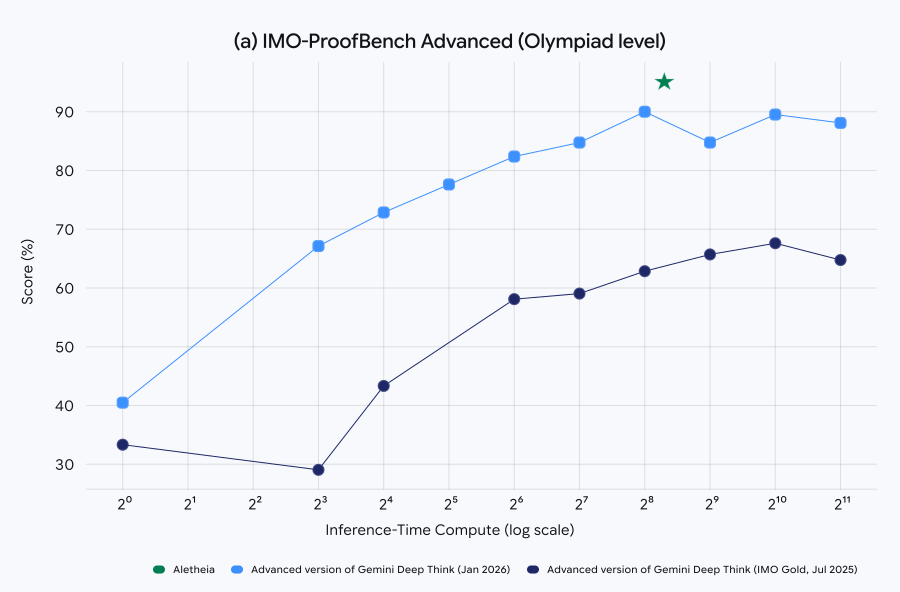
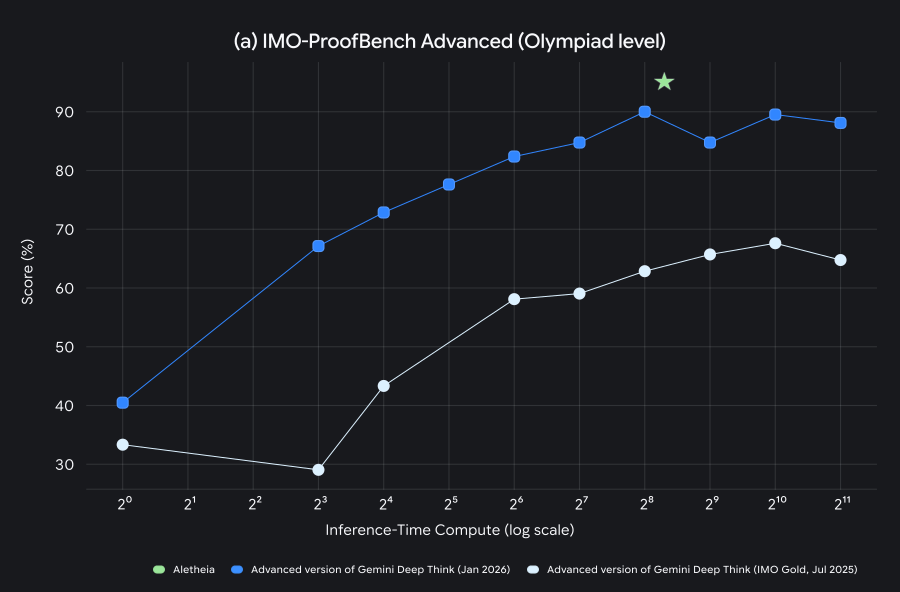
The latest advanced version of Deep Think, as of Jan 2026, has significantly outperformed the IMO-Gold version (Jul 2025) on Olympiad-level problems. Aletheia makes further leaps in terms of reasoning quality with lower inference-time compute. All results were graded by human experts.
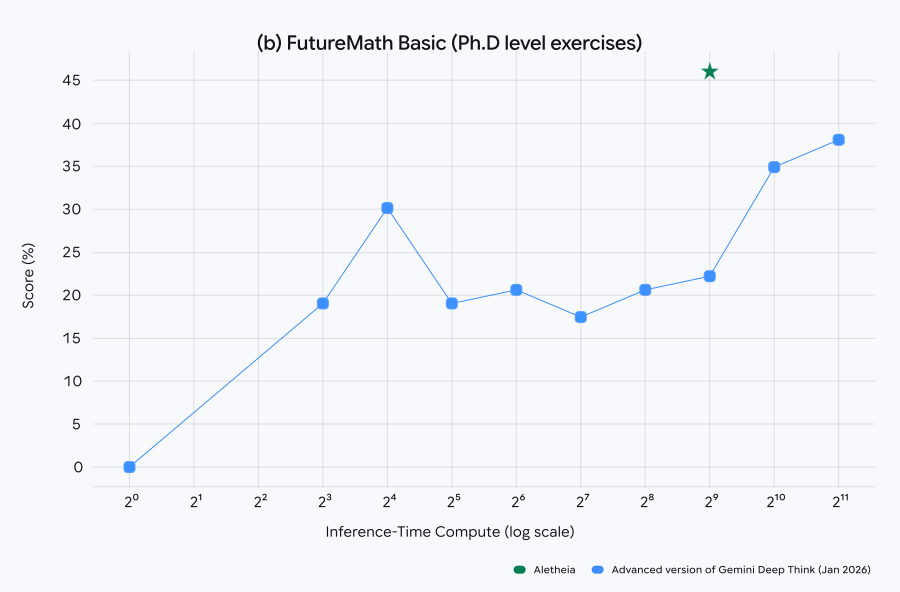
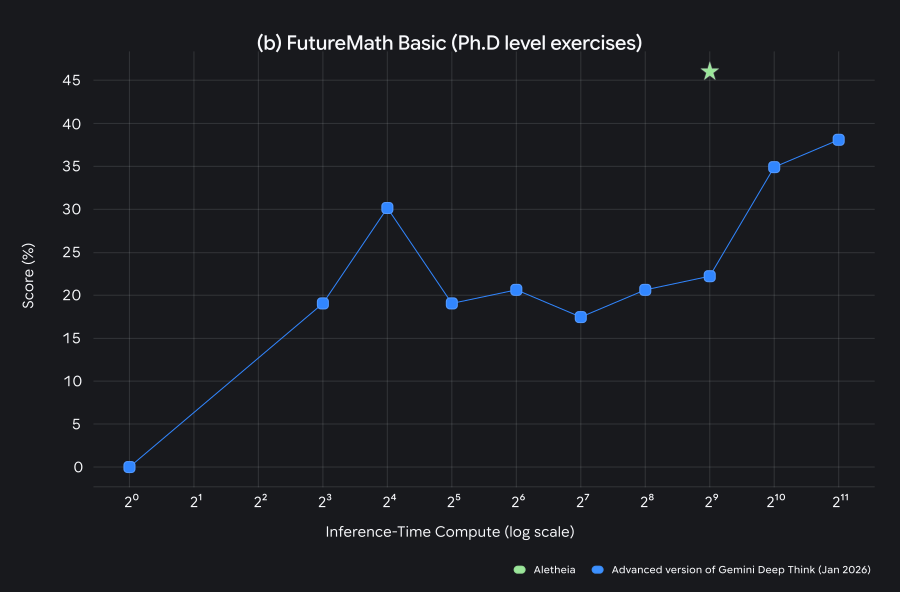
The inference-time scaling law also transfers to PhD-level exercises.
For research-level math, Aletheia has already enabled several advancements, produced via varying levels of autonomous research:
The agent also contributed intermediate propositions on two further papers, (FYZ26) and (ACGKMP26). It is also of note that there has been prior work using Gemini for research-level math at a smaller scale in terms of collaborations and the number of problems tackled.
Following extensive discussions with the mathematical community, we suggest a taxonomy to classify AI-assisted mathematics research by significance and degree of AI contribution - contributing to the wider discussion on responsible documentation, evaluation and communication of AI-generated results. Level 2 (“publishable quality”) works have been submitted to reputable journals. Currently, we do not claim any Level 3 (“Major Advance”) and Level 4 (“Landmark Breakthrough”) results.
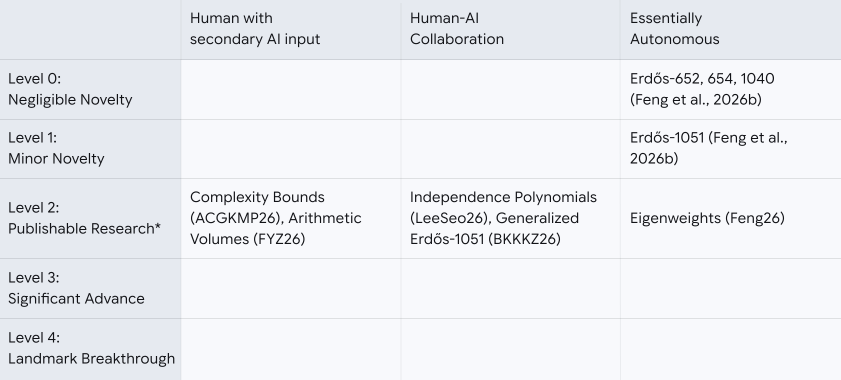
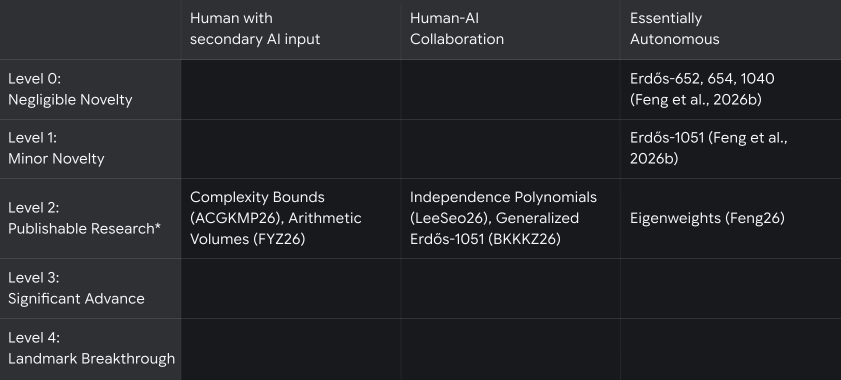
Classification of all AI-assisted mathematics results encompassed in this work. *Works listed as Level 2 in this table have been submitted for publications.
Prompts and model outputs are available here. For discussions on AI contributions, our “Human-AI Interaction card”, and community impact, see our paper.
Gemini Deep Think mode has also demonstrated promise in computer science and physics. The second paper builds on similar agentic reasoning ideas, and identifies effective "recipes" for collaboration, specifically the "Advisor" model, where humans guide AI through iterative "Vibe-Proving" cycles to validate intuition and refine proofs. We also detail tactical techniques like “balanced prompting” —requesting simultaneous proof or refutation to prevent confirmation bias—and code-assisted verification. These methods, combined with the model's ability to bridge disparate scientific fields through deep structural connections, are transforming how theoretical research is conducted. This work builds upon our successful deployment of an advanced version of Gemini Deep Think to assist in reviewing CS theory papers for STOC’26 conference.
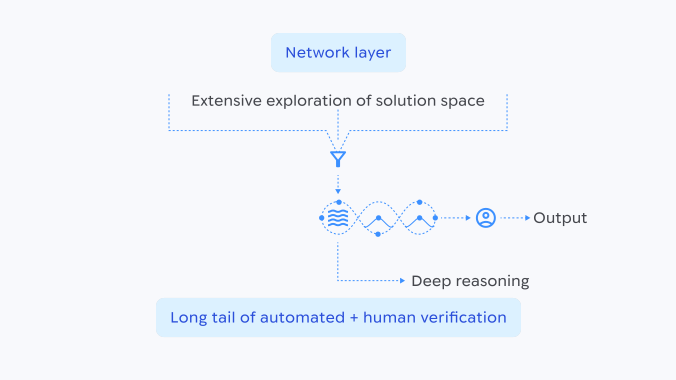
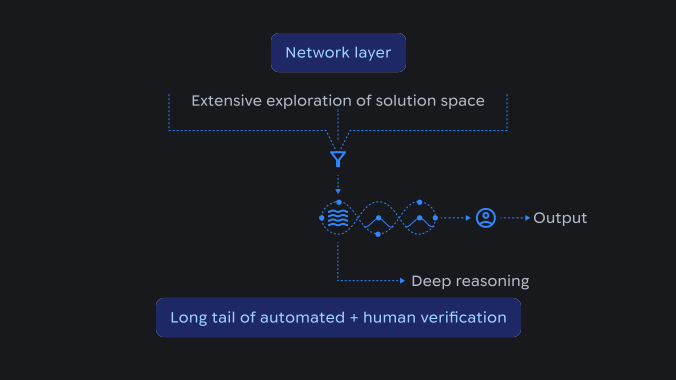
A schematic overview of the AI reasoning pipeline, illustrating how extensive solution space exploration at the network layer is funneled into structured reasoning and validated by automated and human verification.
Collaborating with experts on 18 research problems, an advanced version of Gemini Deep Think helped resolve long-standing bottlenecks across algorithms, ML and combinatorial optimization, information theory, and economics. Highlights from our “Accelerating Research with Gemini” paper include (corresponding section numbers in paper):
Spanning diverse fields—from information and complexity theory to cryptography and mechanism design—the results demonstrate how AI is fundamentally shifting research. For details, see our paper.
Given computer science's fluid, conference-driven publication pipeline, we describe these results by academic trajectory rather than a rigid taxonomy. About half target strong conferences—including an ICLR ’26 acceptance—while most remaining findings will form future journal submissions. Even when course-correcting the field by identifying errors (Section 3.2) or refuting conjectures (Section 3.1), these outcomes highlight AI’s value as a high-level scientific collaborator.
Building on Google’s previous breakthroughs (1, 2, 3, 4, 5), this work demonstrates that general foundation models - leveraged with agentic reasoning workflows - can act as a powerful scientific companion.
Under direction from expert mathematicians, physicists, and computer scientists, Gemini Deep Think mode is proving its utility across fields where complex math, logic and reasoning are core.
We are witnessing a fundamental shift in the scientific workflow. As Gemini evolves, it acts as "force multiplier" for human intellect, handling knowledge retrieval and rigorous verification so scientists can focus on conceptual depth and creative direction. Whether refining proofs, hunting for counterexamples, or linking disconnected fields, AI is becoming a valuable collaborator in the next chapter of scientific progress.
We thank the community of expert mathematicians, physicists, and computer scientists for their help and advice on this project
This project was a large-scale collaboration across Google and its success is due to the combined efforts of many individuals and teams. Thang Luong and Vahab Mirrokni led the overall research directions with deep technical expertises from Tony Feng and David Woodruff.
Authors of the first paper “Towards Autonomous Mathematics Research” include: Tony Feng, Trieu H. Trinh, Garrett Bingham, Dawsen Hwang, Yuri Chervonyi, Junehyuk Jung, Joonkyung Lee, Carlo Pagano, Sang-hyun Kim, Federico Pasqualotto, Sergei Gukov, Jonathan N. Lee, Junsu Kim, Kaiying Hou, Golnaz Ghiasi, Yi Tay, YaGuang Li, Chenkai Kuang, Yuan Liu, Hanzhao (Maggie) Lin, Evan Zheran Liu, Nigamaa Nayakanti, Xiaomeng Yang, Heng-Tze Cheng, Demis Hassabis, Koray Kavukcuoglu, Quoc V. Le, Thang Luong. We thank the following experts for feedback and discussions on the work: Jarod Alper, Kevin Barreto, Thomas Bloom, Sourav Chatterjee, Otis Chodosh, Michael Hutchings, Seongbin Jeon, Youngbeom Jin, Aiden Yuchan Jung, Jiwon Kang, Jimin Kim, Vjekoslav Kovač, Daniel Litt, Ciprian Manolescu, Mona Merling, Agustin Moreno, Carl Schildkraut, Johannes Schmitt, Insuk Seo, Jaehyeon Seo, Terence Tao, Cheng-Chiang Tsai, Ravi Vakil, Zhiwei Yun, Shengtong Zhang, Wei Zhang, Yufei Zhao.
Authors of the second paper “Accelerating Scientific Research with Gemini: Case Studies and Common Techniques” include David P. Woodruff, Vincent Cohen-Addad, Lalit Jain, Jieming Mao, Song Zuo, MohammadHossein Bateni, Simina Branzei, Michael P. Brenner, Lin Chen, Ying Feng, Lance Fortnow, Gang Fu, Ziyi Guan, Zahra Hadizadeh, Mohammad T. Hajiaghayi, Mahdi JafariRaviz, Adel Javanmard, Karthik C. S., Ken-ichi Kawarabayashi, Ravi Kumar, Silvio Lattanzi, Euiwoong Lee, Yi Li, Ioannis Panageas, Dimitris Paparas, Benjamin Przybocki, Bernardo Subercaseaux, Ola Svensson, Shayan Taherijam, Xuan Wu, Eylon Yogev, Morteza Zadimoghaddam, Samson Zhou, Yossi Matias, Jeff Dean, James Manyika, Vahab Mirrokni. This list includes Google researchers building the agentic reasoning on top of Gemini, and our academic expert collaborators verifying and collaborating with Gemini. We also thank Corinna Cortes for her careful review of the paper.
We are grateful for the foundational support from the rest of the DeepThink team: Anirudh Baddepudi, Michael Brenner, Irene Cai, Kristen Chiafullo, Paul Covington, Rumen Dangovski, Chenjie Gu, Huan Gui, Vihan Jain, Rajesh Jayaram, Melvin Johnson, Rosemary Ke, Maciej Kula, Nate Kushman, Jane Labanowski, Steve Li, Pol Moreno, Sidharth Mudgal, William Nelson, Ada Maksutaj Oflazer, Sahitya Potluri, Navneet Potti, Shubha Raghvendra, James Roggeveen, Siamak Shakeri, Archit Sharma, Xinying Song, Mukund Sundararajan, Qijun Tan, Zak Tsai, Erik Wang, Theophane Weber, Winnie Xu, Zicheng Xu, Junwen Yao, Shunyu Yao, Adams Yu, Lijun Yu, and Honglei Zhuang.
We’d like to thank the Gemini Post-Training team for building the foundational model for Deep Think: Arash Ahmadian, Ankesh Anand, Charles Chen, Yong Cheng, Kedar Dhamdhere, Philipp Fränken, Justin Gilmer, Elena Gribovskaya, Luheng He, Yangsibo Huang, Rishabh Joshi, Ajay Kannan, Arvind Kannan, Guangda Lai, Robert Leland, Hanzhao (Maggie) Lin, Yingjie Miao, Bryce Petrini, Corbin Quick, Vikash Sehwag, Yue Song, Pranav Talluri, Ankur Taly, George Tucker, Michael Voznesensky, Manish Reddy Vuyyuru, Yiming Wang, Jinliang Wei, Qiao Zhang, Yuan Zhang, Zizhao Zhang.
We thank Quoc Le, Koray Kavukcuoglu, Demis Hassabis, James Manyika, Yossi Matias, and Jeff Dean for sponsoring this project.
Last but not least, we thank Divy Thakkar, Adam Brown, Vinay Ramasesh, Alex Davies, Thomas Hubert, Eugénie Rives, Pushmeet Kohli, Benoit Schillings for feedback and support of the project.
